
In this article, you will learn how Andes converts Nitrogen’s risk score using volatility.
First, let’s review how the risk score works. We have previously published an article explaining how the risk score is calculated. Our hypothesis is that the risk score can be derived by multiplying volatility by 5. In that article, we illustrated that the average volatility of SPY—an all-equity ETF—is close to 20, which reasonably corresponds to a risk score of 100.
To test this hypothesis, we created a model or portfolio consisting of SPY and BND (Vanguard Total Bond Index). Based on this model, we then constructed a table of portfolios with different asset allocations. The resulting volatilities of these allocations validate our hypothesis that the risk score is equal to volatility multiplied by 5.
You can refer to the tables below:
Table 1: Average volatility of common asset allocations with SPY and BND.
Given that the risk score is based on volatility, we can now convert it to Andes’ patented Risk Tolerance.
Converting Nitrogen Risk Number to Andes Risk Platform
To convert the Nitrogen Risk Number to the Andes platform, we divide the Risk Score by 5 to obtain the volatility of the model portfolio.
Let’s use the below table as a reference for the conversion of your client’s risk score:
Table 2: Andes System Classic Model
If you have a client with a risk score of 25, dividing it by 5 results in a volatility of 5. In the table above, the client would be willing to invest in the Classic Conservative 20/80 model, as it has the closest volatility. This means that, in our Risk Tolerance Test, the client is most comfortable choosing the model below:
Table 3: Andes Risk Tolerance Test
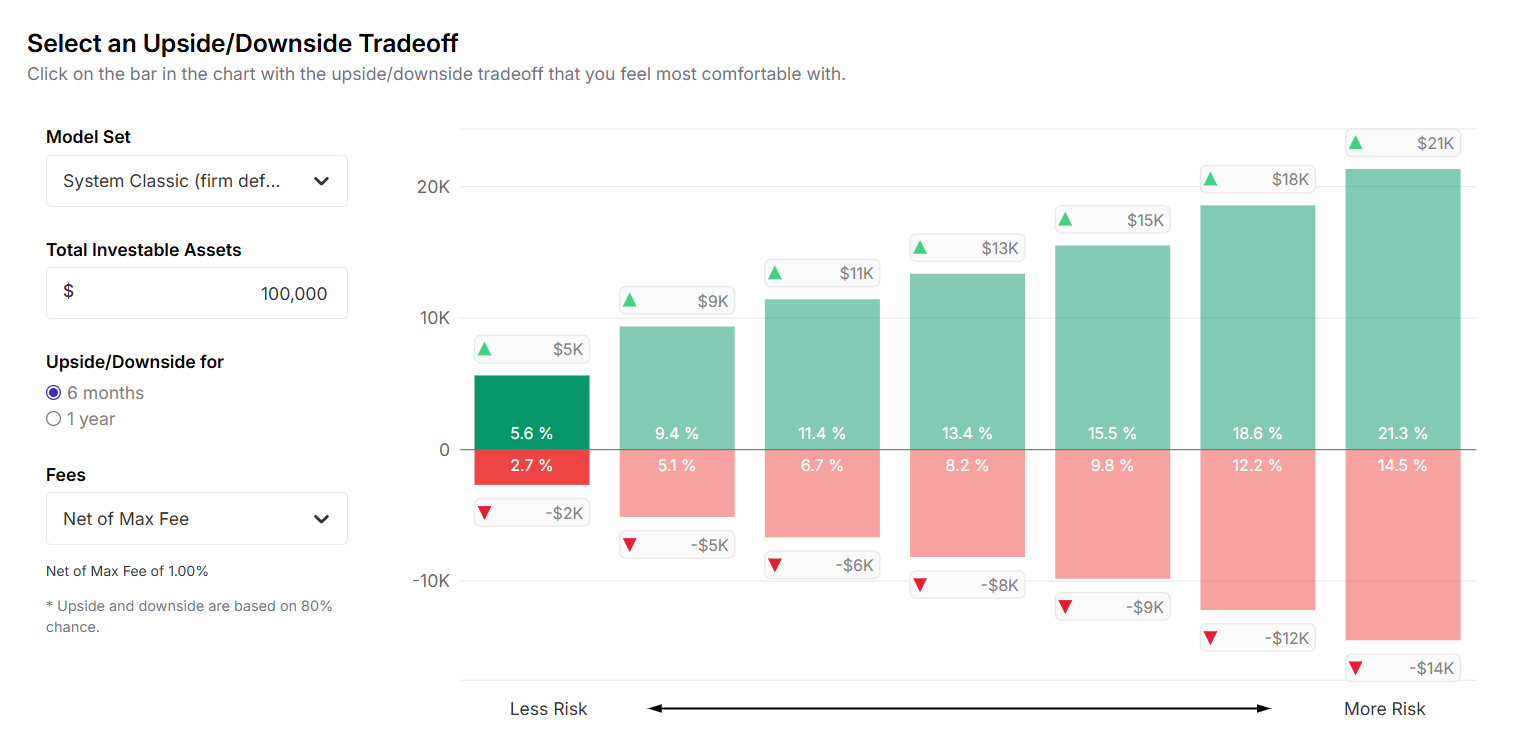
Another example is a client with a risk score of 85, which translates to a volatility of 17 (85 ÷ 5 = 17). When converted to our Risk Tolerance Test, the equivalent model the client is most likely to choose is the Classic Aggressive 85/15 model (see Table 2 for reference).
Summary
In summary, converting Nitrogen risk numbers to the Andes Risk platform is straightforward. If you send us a list, we will take care of the rest.