
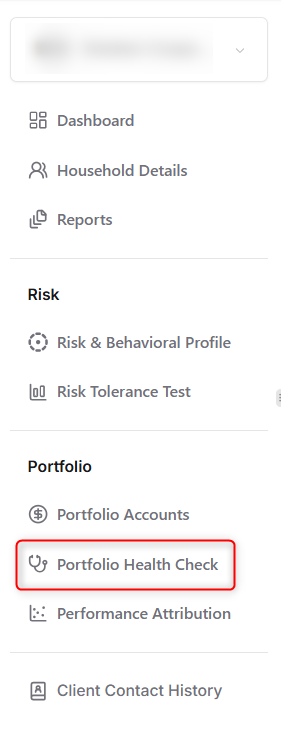
You can use the Portfolio Health Check to visualize portfolio performance within the context of market dynamics. . Access it from the household Dashboard → Portfolio → Portfolio Health Check.
Using Portfolio Health Check to Convert Prospects
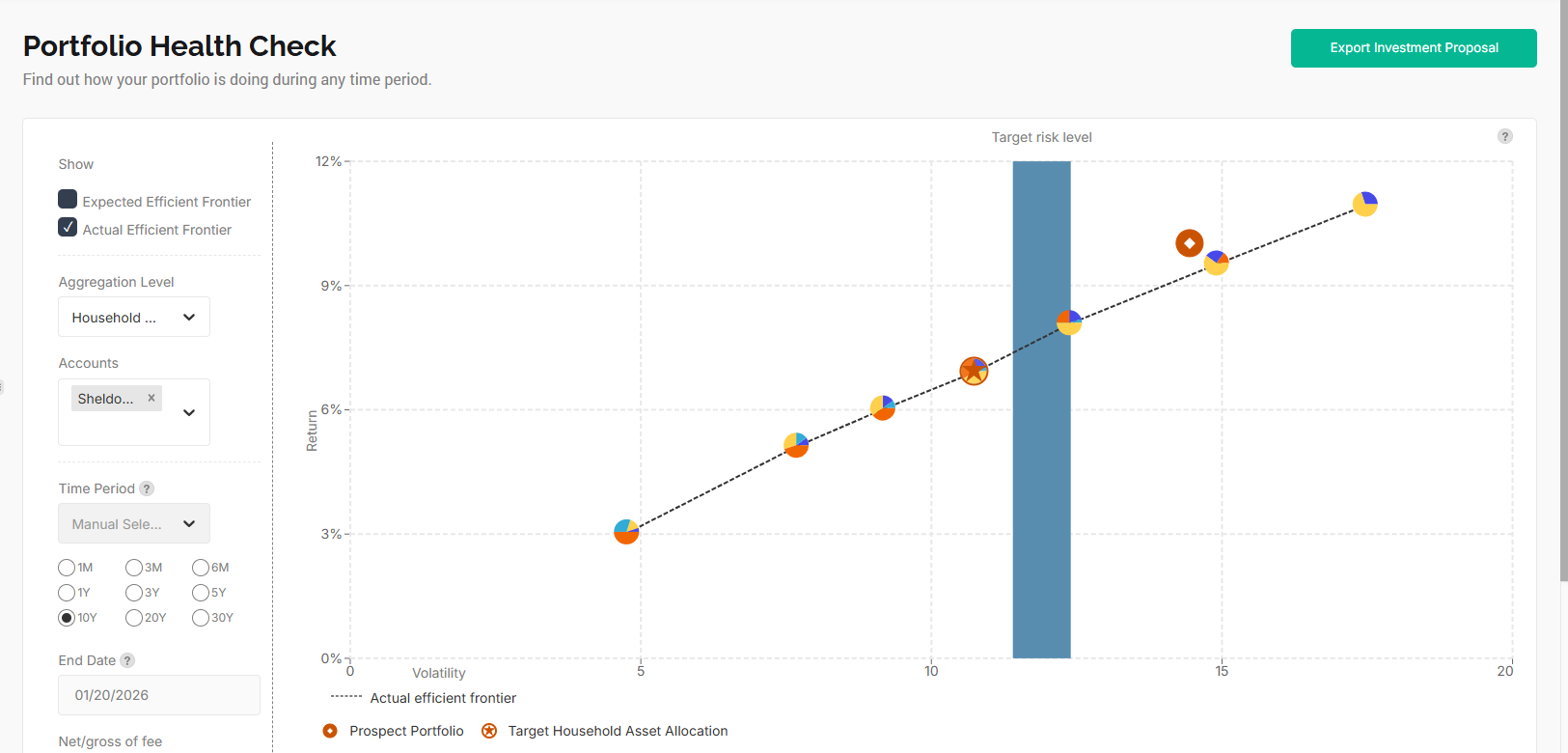
Portfolio Health Check provides an efficient frontier visualization. Each mini pie chart represents a model portfolio from your firm’s model set, collectively forming the efficient frontier.
There are two ways to evaluate portfolio performance:
- Expected Efficient Frontier – Based on capital market assumptions (target return and target volatility), this view is best suited for long-term planning.
- Real-Time Efficient Frontier – Based on actual risk and return over a selected time period.
You can also choose how the portfolio is aggregated:
• Household Level – Aggregates all client portfolios into a single view, providing an overview of the household’s total portfolio.
• Account Level – Displays the performance of each portfolio individually.
Monitoring Portfolio Performance
In the chart below, the vertical blue bar indicates the investor's risk tolerance level from the selected Model in the Household Level Target Asset Allocation.
The orange circle represents the actual risk and return of the prospect’s existing portfolio for the selected time period. In this example, the portfolio carries higher risk than the investor’s risk tolerance and falls below the efficient frontier. This provides a clear opportunity to demonstrate your value as an advisor.
The circle with a star on top indicates the actual risk and return of the proposed portfolio in the target asset allocation.
Monitoring Financial Crisis
This is also a powerful tool for facilitating in-depth conversations during periods of financial stress.
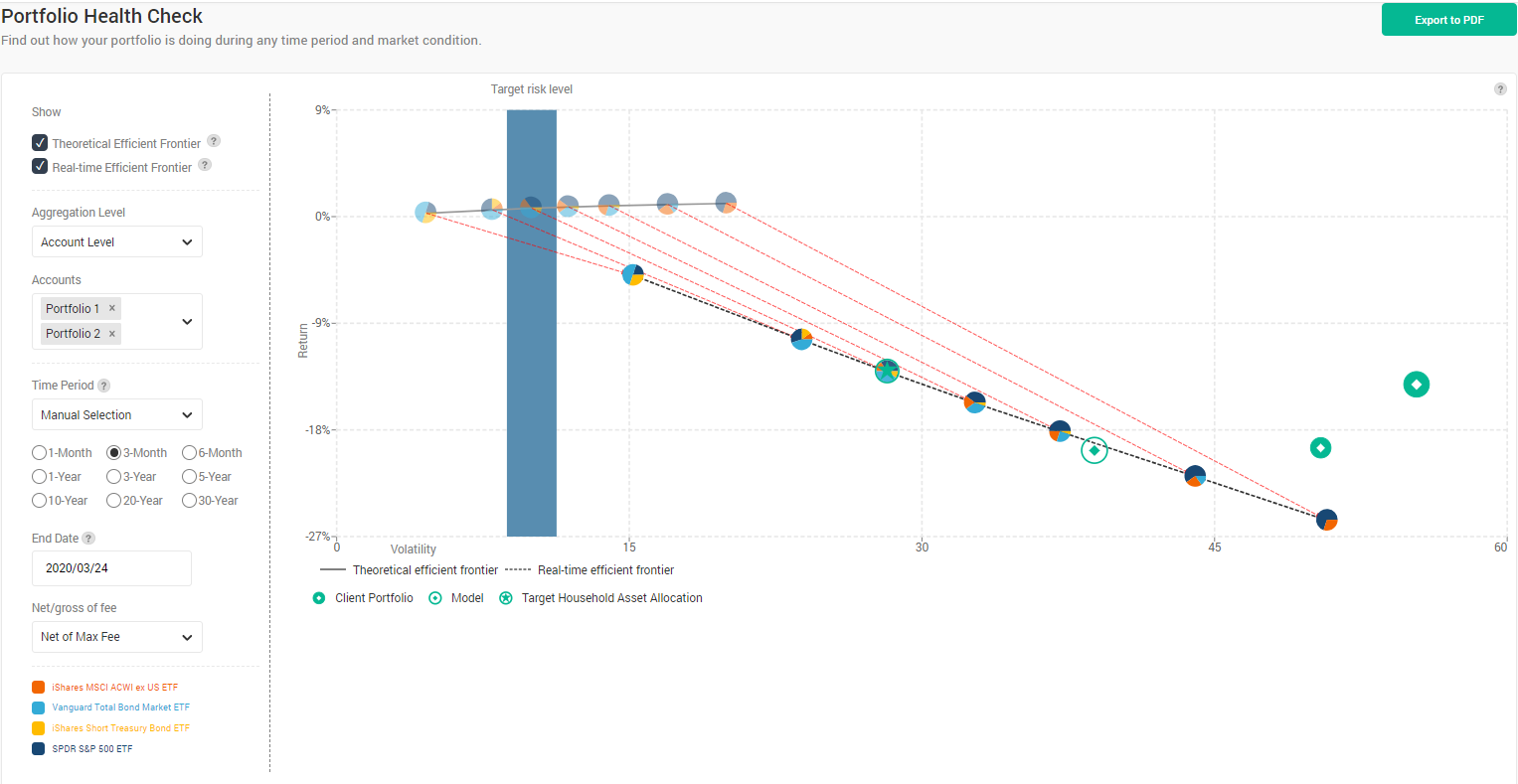
The chart below shows market conditions during the three-month period ending 2024/03/01. As illustrated, all models shifted to the lower right, indicating significantly higher risk and negative returns.
Below is an effective way to guide a conversation with a panicking client:
Start with the 1-month chart. Acknowledge their concerns and show that you are closely monitoring the situation. This view helps demonstrate your understanding of current market conditions—insight they typically don’t have access to elsewhere.
Gradually extend the time horizon to 3 months, 6 months, 1 year, and 3 years. As the timeframe lengthens, the picture almost always becomes less alarming.
Highlight the recovery by adjusting the end date to April, May, and beyond. This helps illustrate the strength of the rebound and reinforces that such recoveries are difficult to predict in real time.
You can also revisit the Emotions chart in the IPS. If the client has completed the Investor Type and Loss Aversion mini-questionnaires, this is an ideal moment to reinforce the key behavioral insights and help them stay grounded.